
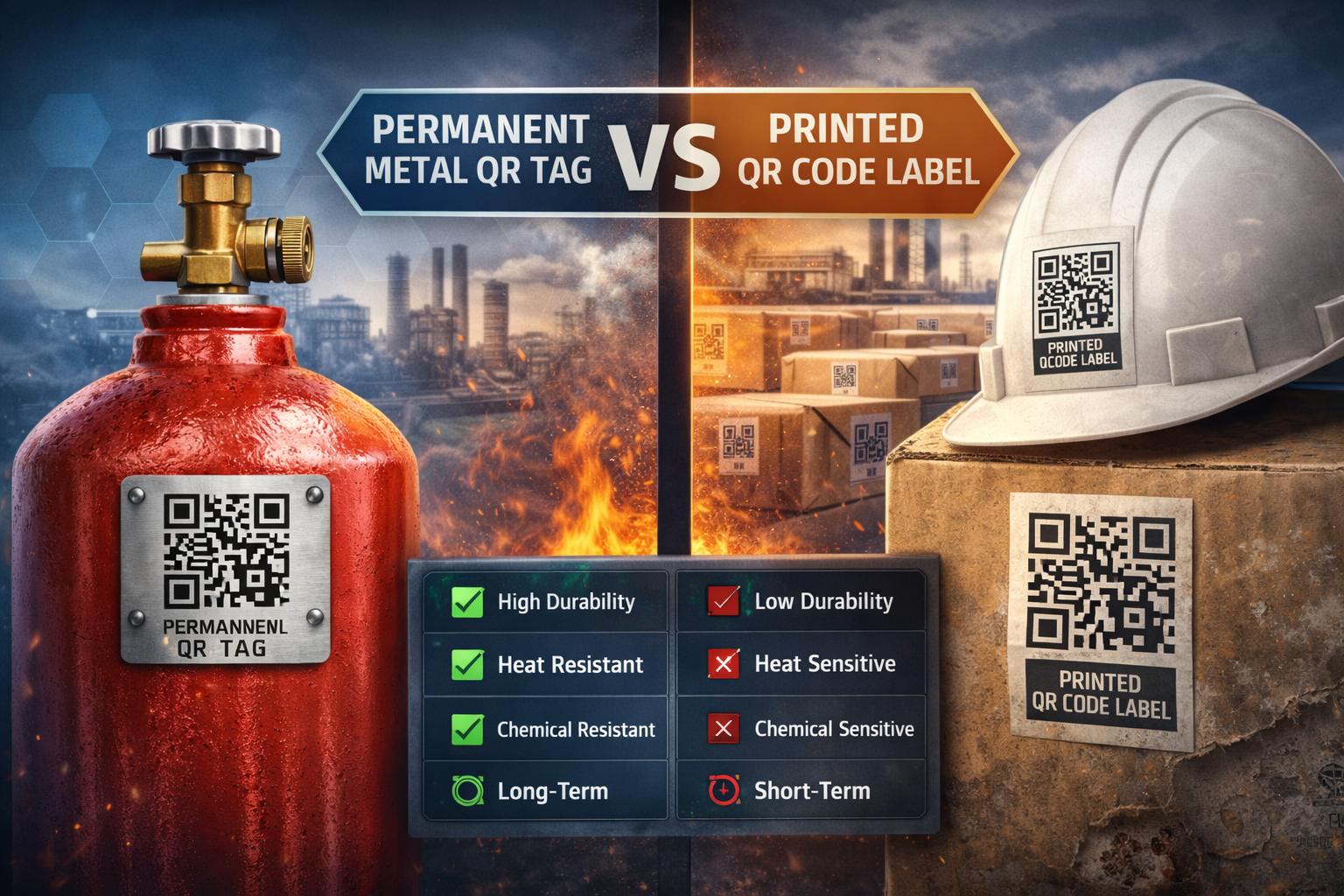
QR codes have quietly become a critical part of industrial traceability — linking physical assets to digital records across manufacturing, logistics, inspection, and safety workflows.
But **not all QR codes are equal.**
In harsh environments — like gas cylinders, chemical plants, fabrication shops, offshore platforms, or long-lifecycle industrial assets — the choice between:
✅ **printed QR labels**
and
✅ **permanent metal QR tags**
…can determine whether your traceability system holds up — or silently breaks in the field.
This post breaks down the differences from a **practical engineering perspective**, based on real-world industrial use cases.
---
## 🏭 **Where QR Codes Are Used in Industry**
Common examples include:
* gas cylinders & pressure vessels
* tools & equipment
* asset inspection tracking
* rental fleets & returnables
* maintenance histories
* compliance certification references
In these workflows, the QR code becomes the **digital identity of the asset** — so reliability matters.
---
# ⚔️ **The Core Problem**
Industrial environments expose assets to:
🔥 heat
🧪 chemicals
🎨 repainting
🚚 abrasion
🌧 weather
🛢 oils & grease
🗓 decades of handling
So the real engineering question is:
> “Which QR marking method survives best over the lifecycle of the asset?”
Let’s compare.
---
# 🖨 **Printed QR Code Labels**
Printed codes are usually:
* sticker labels
* printed plates
* painted/ink-jet codes
They work **very well in controlled environments** (warehouses, IT assets, packaging, retail, etc.)
### ✅ Advantages
✔ low cost
✔ fast to deploy
✔ easy to reprint
✔ minimal tooling
### ❌ Limitations in Industrial Use
Printed codes can:
* fade
* peel
* crack
* blur after repainting
* degrade from UV
* dissolve under chemicals
* burn or deform in high heat
And once the QR becomes unreadable…
👉 **the digital identity is lost.**
In a compliance workflow, that can break:
⚠ audit trails
⚠ inspection logs
⚠ lifecycle traceability
⚠ asset tracking
meaning staff may fall back to **manual workarounds** — or the identity is recreated incorrectly.
---
# 🛡 **Permanent Metal QR Tags**
Metal QR tags are usually:
* stainless steel
* aluminum
* laser-engraved or etched
* mechanically fixed or riveted
The QR is **physically embedded into the metal surface**, not printed on top of it.
### ✅ Advantages
✔ abrasion-resistant
✔ corrosion-tolerant
✔ high-temperature stable
✔ repaint-survivable
✔ mechanically secure
✔ readable for decades
Even if the asset is repainted multiple times, the QR contrast can be preserved or restored.
This is why they are being adopted for:
🟢 gas cylinders
🟢 industrial gases
🟢 petrochemical environments
🟢 defence & aerospace tooling
🟢 heavy equipment
🟢 long-lifecycle regulated assets
Anywhere failure isn’t acceptable.
### ⚠ Considerations
Metal tags require:
* proper mounting design
* field-fit durability testing
* upfront engineering planning
…but once deployed, they rarely need replacement.
---
# 📊 **Side-by-Side Comparison**
| Factor | Printed QR Codes | Permanent Metal QR Tags |
| ---------------------- | ---------------- | ----------------------- |
| Cost | Low | Medium |
| Durability | Low–Medium | Very High |
| Heat Tolerance | Poor | Excellent |
| Chemical Resistance | Low | High |
| Lifecycle | Short | Decades |
| Risk of Failure | High | Very Low |
| Industrial Suitability | Limited | Ideal |
---
# 🔐 **Compliance & Safety Impact**
In regulated industries (like gas cylinders):
📌 inspections
📌 hydrotests
📌 incident investigation
📌 audits
require **trusted identity continuity**.
If a printed code is unreadable:
🟥 traceability breaks
🟥 additional paperwork is needed
🟥 non-conformance risk increases
A permanent identity tag eliminates this fragility.
---
# 🧠 **When Printed QR Labels Still Make Sense**
Printed QR codes are still great for:
✓ inventory boxes
✓ temporary ID
✓ internal logistics
✓ warehouse operations
✓ short-lifecycle products
This is not a “print is bad” argument.
It’s about **use-case fit**.
---
# 🧪 **Engineering Rule-of-Thumb**
> **If the asset lifecycle is >3 years and exposed to harsh handling — use a permanent QR solution.**
Otherwise — printed labels are fine.
---
# 🌍 **Industry Direction**
Globally, we are seeing:
🔹 migration from serial stamping → QR identity
🔹 more lifecycle-based traceability
🔹 greater regulatory digitalization
🔹 higher safety expectations
Permanent metal QR identity is becoming **part of that transformation.**
---
# 💬 **Final Thoughts**
For industrial environments, QR codes must survive the real world — not just the factory floor.
Printed QR labels are excellent for low-stress use cases.
But where heat, abrasion, weather, or repainting are expected…
👉 **metal QR identity tags dramatically reduce failure risk — and protect traceability integrity.**
---
## ⚠️ Transparency Note
I work in QR-based industrial traceability.
If you’re curious about real-world metal QR identity tagging used in regulated industrial environments (like gas cylinders), here’s a reference page:
👉 [https://metalqrcodetags.posttech.co/peso-metal-qr-cylinder-tags.php](https://metalqrcodetags.posttech.co/peso-metal-qr-cylinder-tags.php)
Not a sales pitch — just sharing an example for those evaluating durability options.

Posttech Support Team
Posted on
Permanent Metal QR Tags vs Printed QR Codes — Which Works Better in Industrial Environments?
For further actions, you may consider blocking this person and/or reporting abuse


Top comments (0)